For most of the last decade, local SEO for trade businesses followed a simple enough formula. Pick your main keywords, put them on your pages, get a few backlinks, claim your Google Business Profile, collect some reviews. Stay consistent and you’d show up when someone searched for a plumber or electrician in your area.
That formula still matters. But it’s no longer enough on its own, and the businesses that are still running it unchanged are starting to notice their rankings slipping without understanding why.
What changed isn’t one thing. It’s several things happening at the same time, and they’re compounding. Understanding what shifted and what to do about it is the difference between staying visible in your local market and watching competitors pull ahead while your phone gets quieter.
What Actually Changed
Google’s approach to local search has been evolving steadily, but 2024 and 2025 brought changes significant enough that businesses running old strategies are feeling the effects now.
The helpful content updates of the past two years hit thin, keyword-stuffed local pages particularly hard. Pages that existed purely to rank — a paragraph of text with the city name and service type repeated throughout, no real information, no depth — lost rankings in bulk. Google got substantially better at distinguishing pages that exist to help the person searching from pages that exist only to capture the search.
AI-generated search features changed how results are displayed. In many searches, especially informational ones, Google now provides a direct answer at the top of the results page. To be the source that answer comes from, the page needs to actually answer the question thoroughly and clearly — not just contain the keywords.
The map pack algorithm, which determines which three businesses appear in the local map results, now weights review recency and response rate more heavily than it did two years ago. A business with 200 reviews collected over five years but nothing in the last six months ranks below a business with 60 reviews that are consistently fresh. Freshness signals activity. Activity signals a reliable, operating business.
Proximity still matters for local pack results, but it’s no longer dominant in the way it once was. A business five kilometers from the searcher with stronger relevance signals — better reviews, more complete GBP, more specific content — now regularly outranks a business two kilometers away that’s done less work on those signals.
Why Keywords Alone Stopped Working
The fundamental shift is that Google stopped treating local SEO as primarily a keyword-matching exercise and started treating it as a relevance and authority assessment.
Putting “emergency plumber Sydney” on your homepage still matters. But it’s now a baseline requirement, not a differentiator. Every serious competitor in your area has done that. The question Google is asking now is which business, among all the ones using those keywords, is most credible, most relevant, and most likely to actually serve the searcher well.
That assessment draws on signals that keyword placement alone can’t provide. How complete is the Google Business Profile? How recent and how numerous are the reviews? Does the website have content that answers the specific questions people in this area are searching for? Does the site load quickly on mobile? Are there other credible sites linking to or mentioning this business?
A plumbing company whose entire SEO strategy is putting “plumber [city]” in headings is competing against plumbing companies whose strategy is demonstrating expertise, consistency, and local relevance across multiple channels simultaneously. Those are not even matches.
The Map Pack and What Drives It Now
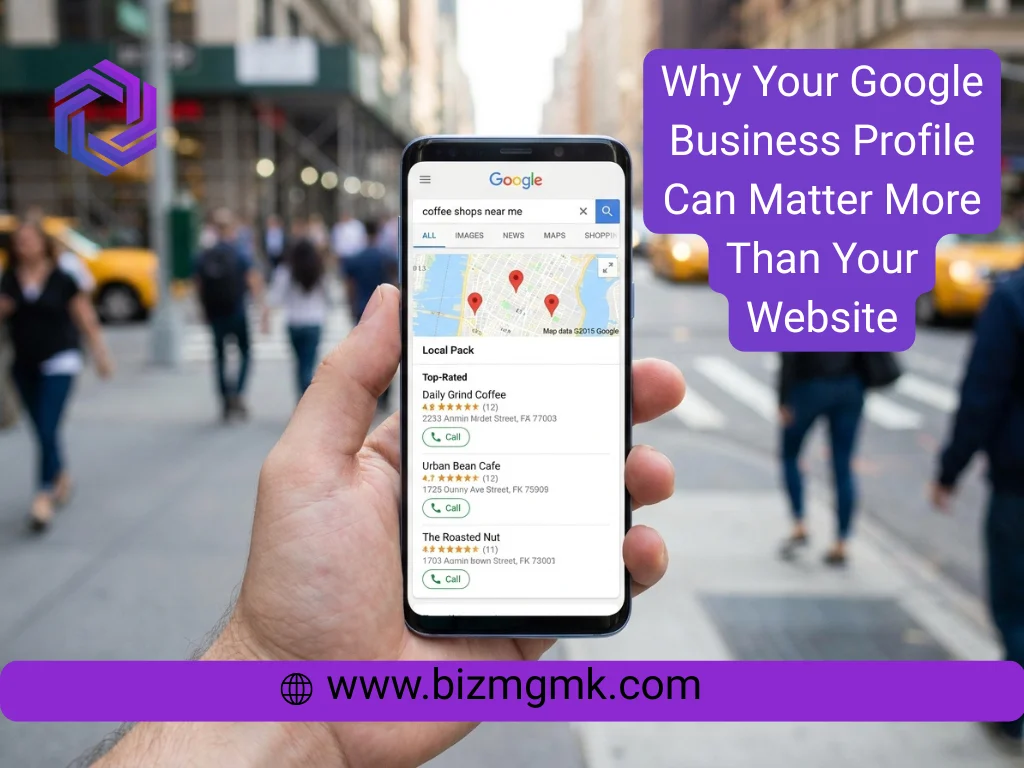
The three-pack — the map results that appear above organic listings for local service searches — is where most trade business leads come from. Ranking in it versus ranking below it is not a marginal difference. It’s the difference between getting called regularly and getting called occasionally.
The factors driving map pack rankings have shifted in their relative weight.
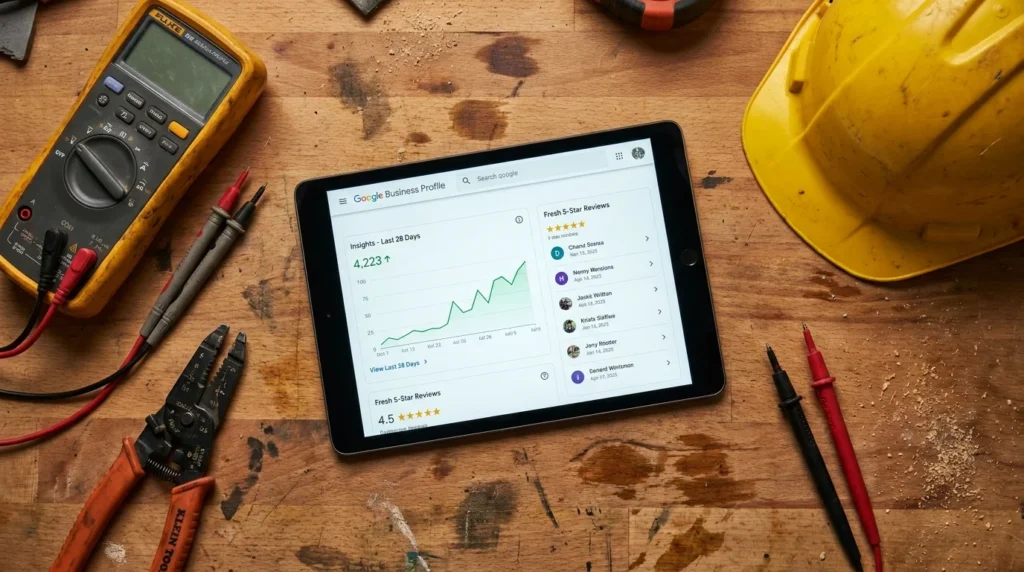
Google Business Profile completeness is more important than ever. Not just claimed and filled in — genuinely complete. Every service listed individually, service areas specified properly, business hours current including public holidays, photos uploaded consistently, the business description written to explain specifically what you do and where. GBP profiles that were completed once two years ago and never touched are performing worse than profiles that are actively maintained.
Review velocity matters alongside total review count. Ten reviews a month signals an active, busy business. Two reviews a month from a business with 300 total still signals lower activity than one with 80 total collecting ten a month. Google interprets consistent new reviews as a sign the business is operating well and customers are willing to vouch for it.
Behavioral signals — how often your listing gets clicks, how many people request directions, how many call directly from the listing — factor into rankings. A listing that people interact with frequently is interpreted as more relevant to searchers in that area. This means your GBP photos, your review responses, and even your business description affect not just whether people click but how Google ranks you over time.
Citation consistency still matters. Your business name, address, and phone number need to be identical across Google, your website, Facebook, industry directories, and anywhere else they appear. Inconsistencies — even minor ones like “St” versus “Street” — create conflicting signals that dilute your local authority.
Localized Content and Why It Matters

This is the area where most trade businesses have the biggest gap and the biggest opportunity.
Localized content means pages, posts, or content sections that are specifically about the areas you serve — not just a list of suburb names dropped into a footer, but actual content relevant to customers in those areas.
A plumber serving multiple suburbs who has a dedicated page for each suburb — covering common plumbing issues in that area, local water quality considerations, typical job types they handle there, response times — gives Google something to rank for suburb-level searches that a single city-level page can’t compete with.
An electrician with a page specifically about switchboard upgrades, written to explain what the process involves, what it costs in approximate terms, how long it takes, and what triggers the need for one, will rank for searches about switchboard upgrades in their area. A competitor with a services page that just lists “switchboard upgrades” as one of twelve bullet points won’t.
The content doesn’t need to be long or literary. It needs to be specific, accurate, and genuinely useful to someone who is about to hire someone for that job. A customer researching whether they need a full rewire or just a switchboard upgrade is actively in the decision process. A page that answers that question clearly, from a local electrician, is exactly what they’re looking for — and exactly what Google wants to show them.
Blog content compounds over time. A plumbing company that publishes one useful, specific article per month — about seasonal pipe issues, how to choose a hot water system, what to do when a drain keeps blocking, how to read a water meter — is building a library of locally relevant content that attracts search traffic for years. A competitor publishing nothing is handing that traffic over.
Matching What Customers Actually Search For
The way people search for trade services has changed, and the way they search when using AI tools is different again.
Traditional search: “plumber Sydney.” Short, keyword-based, location plus service.
Modern search: “why does my hot water run out after 10 minutes” or “cost to replace hot water system 2026” or “emergency plumber available now [suburb].” Longer, more specific, phrased as a question or a situation rather than a keyword.
AI-assisted search via tools like ChatGPT, Perplexity, and Google’s AI Overviews: “which plumbers in [suburb] have good reviews for hot water repairs” or “who should I call for a gas leak in [area].” Conversational, trust-based, asking for a recommendation rather than a search result.
A plumbing or electrical site built around short keywords answers the first type of search adequately. It largely fails the second and third types because the content doesn’t match how the question was phrased and doesn’t provide enough depth to be cited as a useful source.
Building content around the actual questions customers ask — in the language they use, with enough detail to genuinely answer — is what positions a site to capture modern search traffic across all three formats. This is not about writing for robots. It’s about writing the page a customer would be relieved to find because it actually told them what they needed to know.

What a Site Revamp Fixes That Nothing Else Can
Some of what’s described above can be addressed without touching the website. GBP improvements, review collection, citation cleanup — these are external changes that don’t require a redesign.
But a site that was built three to five years ago without mobile performance, without a content structure that supports localized pages, without fast load times, without schema markup that tells Google what your business does and where — that site has a ceiling. You can optimize around the edges but you can’t fix the foundation without rebuilding it.
A revamped site built with current local SEO requirements in mind gives you a platform that can actually support the strategy. Pages that can be added for each service and suburb without breaking the structure. Load times that don’t cost you rankings on mobile. Technical foundations — proper heading hierarchy, schema, internal linking — that let Google understand and index your site correctly.
The businesses that will dominate local search in their trades over the next two to three years are the ones building that foundation now, before their competitors get around to it. Local SEO in most trade markets is not yet saturated at the level of quality that’s possible. There is still a real first-mover advantage for the businesses that take it seriously before everyone else does.