
Hiring a contractor, a roofer, or a landscaper is not like buying a product off a shelf. The customer can’t try it before they commit. They can’t return it if it doesn’t work out. They’re handing over a significant amount of money for work that will be done to their home or property, and they have no way to evaluate the quality of that work until it’s already finished.
That’s a lot of trust to ask for from a stranger.
The way customers manage that risk is by looking for evidence. Not promises, not bullet points about your commitment to quality, not a list of services with stock photos. Actual evidence of work you’ve done, how it turned out, and what real clients said about the experience.
If your website doesn’t provide that evidence — or provides it poorly — you’re asking customers to trust you on faith alone. Some will. Most will click to whoever has better proof.
What Old or Missing Portfolios Signal
A portfolio that hasn’t been updated since 2018 doesn’t just look old. It raises questions.
Are they still operating? Have standards slipped? Is this the quality of work they’re doing now, or was this the best they ever did? Are there no recent jobs because there are no recent jobs?
None of those questions are fair. You might be busier than ever. But a potential customer doesn’t know that, and they’re making decisions based on what they can see. An outdated gallery is better than nothing, but not by much — because the jobs it shows are years old and the photography is probably from a phone camera held at an awkward angle in bad light.
No portfolio at all is worse. A roofing company or general contractor with no photos of their work on their website is, to a new customer, indistinguishable from a company that has no work worth showing. That’s an unfair assumption, but it’s the assumption that gets made.
The same logic applies to landscapers and lawn care companies who show up, do genuinely excellent work transforming a property, then drive away without documenting any of it. The evidence existed for about four hours. Now it’s gone, and the next customer has nothing to look at.

What a Modern Portfolio Actually Looks Like
A modern portfolio is not a photo gallery page with a grid of small thumbnails that open into a lightbox. That format was standard ten years ago. Now it reads as dated and makes it hard for customers to understand what they’re actually looking at.
What works now is organized, labeled, story-driven visual content.
Each portfolio entry should have a project name or type, a location (suburb or city level, not the full address), a brief description of what the job involved, and the photos. Not one photo — multiple photos that show the scope of the work. Wide shots that show the full result, close-up shots that show the quality of the detail, and ideally a photo that gives a sense of scale.
Captions matter more than most people think. A photo of a completed roof with no caption is just a roof. A photo with “Complete tear-off and replacement on a 1970s double-story in Greenfield — stripped to deck, new underlayment, GAF Timberline shingles in Charcoal” tells a customer you know what you’re doing, you’re specific, and you stand behind what you’ve built. That’s the difference between a photo gallery and a portfolio.
Organizing by project type rather than by date helps customers find what’s relevant to them. A homeowner looking for a bathroom renovation doesn’t want to scroll through twenty kitchen jobs and two commercial fit-outs to find what they came for. Group by category, make it navigable.
Before-and-After Done Right
Before-and-after photos are the most powerful content a visual trade business can produce. They do in two images what paragraphs of copy can’t — they show the transformation, make it concrete, and let customers project their own situation onto it.
But most before-and-afters are done badly enough that they undercut the effect.
The most common failure is inconsistent framing. The before photo is taken from one angle in one kind of light, and the after photo is taken from a completely different position on a different day. The viewer can’t make a clean comparison because they’re looking at two different perspectives on the same space. This makes the transformation look smaller than it was.

Take the before photo with the transformation in mind. Same spot, same angle, same approximate time of day if you can manage it. When the after photo matches the before exactly except for the work you’ve done, the contrast is immediate and striking. That’s what stops someone scrolling and makes them save the photo to show their partner.
Lighting is the other variable most trade businesses ignore. A kitchen renovation photographed on an overcast day through a small window looks dim and unimpressive. The same kitchen photographed with the lights on and natural light from a good angle looks like a magazine spread. You don’t need a professional photographer for every job. You need to take the after photos at the right time of day with the lights on.
For landscaping and lawn care businesses especially, the before-and-after is almost the entire sales pitch. A front yard that was patchy, overgrown, and neglected transformed into something clean and structured tells the story of what you can do better than any written description. If you’re a landscaper not taking before photos at the start of every significant job, you are leaving your most powerful marketing tool unused on every single project.
Case Studies for Higher-Ticket Work
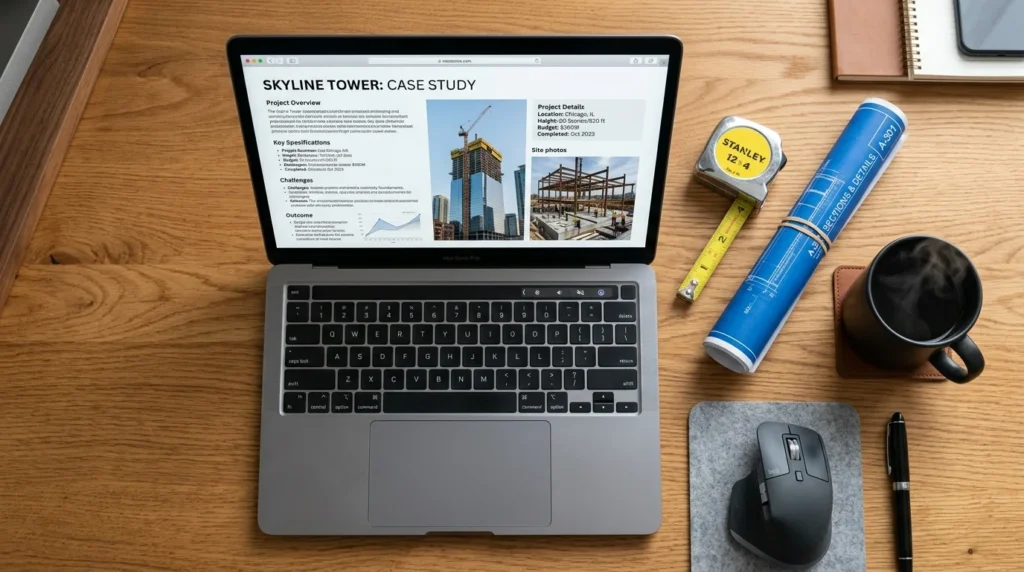
For larger projects — full home extensions, commercial landscaping contracts, complete roof replacements on large properties, major renovations — a simple before-and-after with a caption isn’t enough. The project deserves a case study.
A case study is a short written account of the job: what the client needed, what the challenges were, how you approached it, and what the outcome was. Three to five paragraphs, several photos showing different stages and angles, and a client quote at the end if you have one.
This format does several things a photo gallery can’t. It shows your thinking, not just your output. It demonstrates that you can handle complex jobs with multiple moving parts. It gives customers a sense of what working with you looks like from start to finish. And it ranks in Google searches — a well-written case study page about a specific project type in a specific location will often pull search traffic for years.
A general contractor who publishes a case study on a complete kitchen and bathroom renovation in a named suburb, with real project photos and a genuine client account of the experience, is more credible than a contractor with the same quality of work who just has a photo grid. The writing creates depth. The depth creates trust.
For roofing companies, case studies that explain why a particular material was chosen for a particular situation — the pitch of the roof, the local weather conditions, the client’s budget — establish expertise in a way that photos alone don’t. Customers hiring for high-ticket work want to believe you know what you’re doing. A case study shows the reasoning, not just the result.
Where to Put This Content So It Gets Seen
The mistake most trade businesses make is burying their portfolio. They build a site with a home page, a services page, an about page, a contact page, and then a gallery page at the bottom of the navigation that gets a fraction of the traffic everything else does.
The work should be on the homepage. Not a link to a gallery page — actual photos, pulled from recent projects, visible without clicking anywhere. A homeowner landing on a roofing company’s homepage should see real jobs within the first scroll. If they have to navigate to find evidence of your work, many won’t.
Individual services pages should feature relevant portfolio photos. A landscaping company’s page about garden design should show garden design projects. The roofing company’s page about flat roofs should show flat roof jobs. Customers on a service page are already interested in that specific thing — showing them evidence of you doing exactly that thing is the most direct path to a conversion.
Case studies belong in a dedicated section that’s easy to find and easy to share. Customers who are seriously considering hiring you often share your site with a partner or family member to get a second opinion. A case study page that tells a complete story is far more shareable and persuasive than a generic gallery.
On Google Business Profile, photos are free and visible to every potential customer who finds you in local search before they’ve even visited your site. Upload real job photos regularly — not the same three photos you uploaded when you first claimed the profile. Active, current photos signal an active, current business.

The compounding value of a strong portfolio is that it works continuously. A case study published today gets indexed by Google and can pull search traffic for the next three years. A set of before-and-after photos on your homepage converts visitors this week and next month and the month after that. The hour you spend photographing a finished job and writing two paragraphs about it pays returns long after the job itself is finished and paid.
The businesses winning the most work in visual trades aren’t always the best at the work. They’re the best at showing the work. In a market where customers can’t evaluate quality until after they’ve hired you, whoever tells the most credible visual story wins the consideration.