Small business owners spend hours picking fonts and logo colors. Meanwhile, the social media bio sits blank. The last post is from eight months ago. And somehow, nobody’s calling.
Here’s the part most people miss: AI tools now shape buying decisions in ways that didn’t exist three years ago. When someone asks ChatGPT, Perplexity, or Google’s AI Overview to recommend a local dentist, plumber, or marketing agency, those tools pull signals from across the web. Your social profiles are part of what they read. If your social media is invisible to AI, you’re not just losing followers — you’re getting skipped by the recommendation engine before a human ever sees your name.
How AI Actually Reads Your Social Presence
AI assistants don’t scroll social media the way a person does on their lunch break. They process publicly available data: profile text, post frequency, keywords in captions, engagement patterns, and how recently you’ve been active. What they’re trying to establish is whether your business is real, relevant, and worth recommending for a specific topic or location.
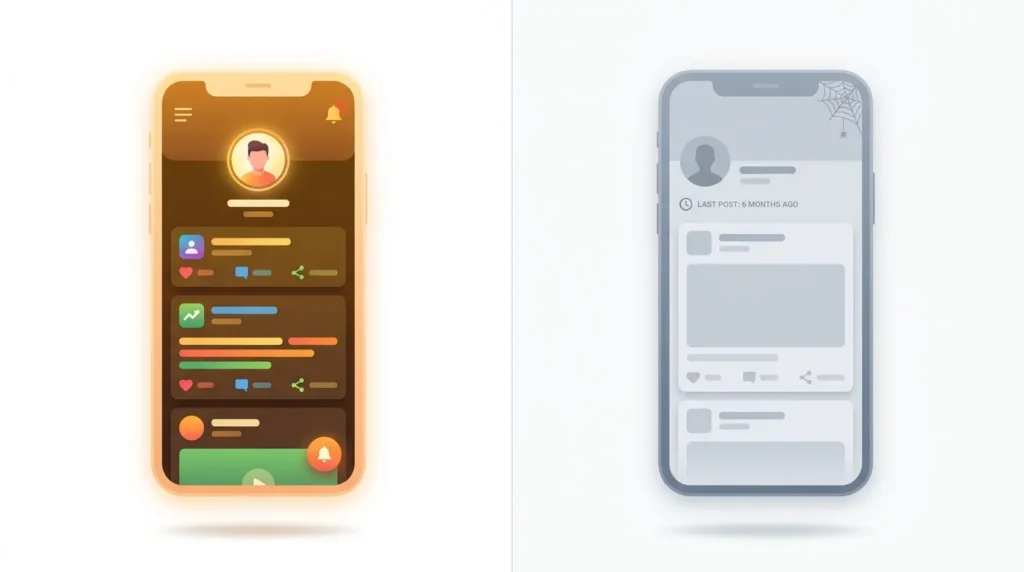
A complete bio, regular posts that mention your actual services, and captions with real language — not emoji clusters — send a clear signal. A half-filled page with three posts from 2022 sends a different one. It suggests you’re either closed, unreliable, or just not paying attention. None of those are qualities people want in a dentist or a plumber.
Why a Dead Profile Hurts You Twice
The first hit is obvious. A human finds your page, sees nothing recent, and backs out. Assume the worst is basically the default behavior when there’s no evidence otherwise.
The second hit is quieter. AI tools weight recency and activity when pulling business recommendations. A profile that hasn’t moved in six months contributes almost nothing to your discoverability. So you’re invisible to the algorithm before the human even gets a chance to judge you. You lose both.

Profile Basics That Humans and AI Both Need
Skip the vague stuff. Your bio should say what you do, who you help, and where you’re located — plainly. Not “passionate visionary helping clients unlock potential.” Something closer to: “Family dental clinic in Austin. Accepting new patients. Same-day appointments available.”
Fill in every field the platform offers: category, location, hours, website, contact options. Those aren’t just nice-to-haves. They’re data points AI systems read when deciding whether your business matches a search query. Empty fields look like gaps. Gaps hurt.
Content That Actually Builds Authority
Hashtags won’t save you here. Keyword-rich captions will.
When you post a before-and-after of a tile job, there’s a wrong way and a right way to caption it.
Wrong: “Check out this transformation! #homeimprovement #austintx”
Right: “We replaced cracked bathroom tile in a 1980s Austin home last week. The owner wanted something low-maintenance, so we went with matte porcelain. Here’s how it turned out.”
The second version tells AI what you do, where you work, and what type of problem you solve. It gives a human reader something real to engage with. The hashtag-only version gives everyone almost nothing.
Post content that answers questions your customers actually type into search: “How long does a crown take?” “What’s the difference between a deep clean and a regular clean?” “Do I need a permit to replace a water heater in Texas?” Those questions live in AI training data. Answering them on your page — in plain, specific language — builds topical relevance over time.
Staying Consistent Without Burning Out

Volume is not the goal. Consistency is.
Three solid posts a week, sustained for six months, will do more for your AI visibility than 20 posts in a panic followed by silence. Pick a schedule you can actually keep. Once a week works if you don’t miss it.
Batch your content. Two hours on a Sunday can fill the next two weeks. Use a free scheduler. You don’t need a social media manager for this — you need a repeatable system.
If you’re stuck on what to post, here are three things that work every time: answer a common question a customer asked you this week, show a finished job with a real description of the work, or explain one thing you do differently from whoever’s down the street. Rotate those. Done.
Where to Go From Here
If reading this made you glance at your Facebook page and wince — that’s useful information. The gap between where you are and where AI tools can find you is usually smaller than people think. But it doesn’t close on its own.
Not sure your social is working for you?
Find out exactly where you stand.