What changed — and why your site might be invisible now
A couple of years ago, someone needed a dentist. They opened Google, typed “dentist near me,” and scrolled a list of links. Your site showed up. They clicked. They called.
That still happens. But it’s not the whole picture anymore.
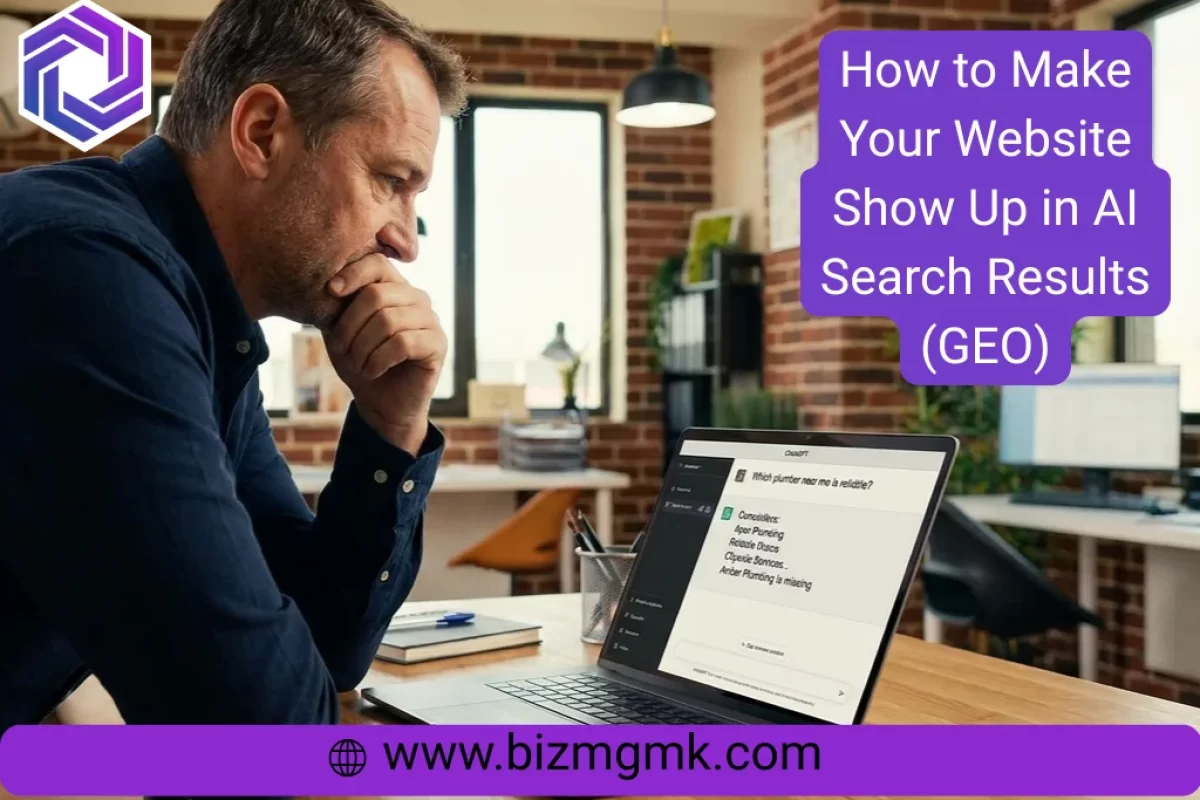
Now people open ChatGPT or Google’s AI Overview and just ask. “Which dental clinic in [city] is good for families?” “What should I look for in a plumber?” “Is this law firm any good?” “Which med spa near me does laser treatments?” “What should I ask a real estate agent before signing?” The AI answers — in full sentences, with specific names — without the person clicking a single link.
If your website isn’t readable by AI, you’re not in that answer. You don’t exist for that customer.
This is called GEO: Generative Engine Optimization. Most local business owners haven’t heard of it yet. That’s either a problem or an opportunity, depending on how fast you move.
How AI decides which businesses to mention
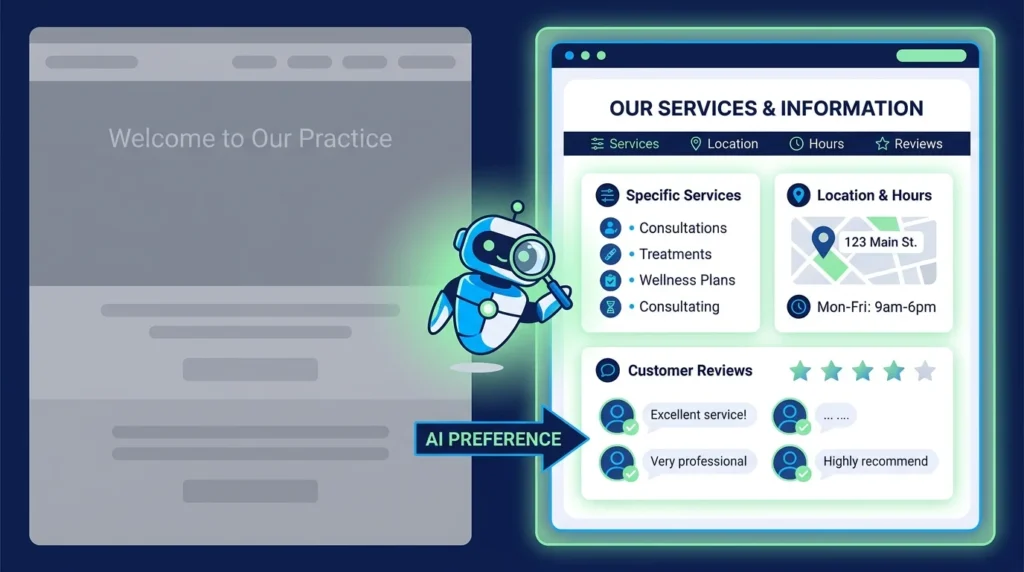
AI tools don’t rank sites the way Google does. They pull from their training data and from what they can read on your site right now. When someone asks about a local service, the AI reaches for businesses that give it something to work with.
Clear, specific information wins. If your homepage says “Welcome to our practice,” the AI has nothing useful. If it says “We’re a family dental clinic in Austin offering same-day crowns and accepting Delta Dental insurance” — that’s quotable. The AI can pull that into an answer.
Outside mentions matter. Your business name in local news, directories, review platforms, or industry sites makes AI systems more likely to surface you. It works like a citation. The more places you’re named, the more credible you look to a machine trying to figure out if you’re real and relevant.
Structured data helps AI understand you. Schema markup is a block of code (invisible to visitors, readable by AI) that tells search engines what your business actually is. Without it, the AI guesses. Sometimes it guesses wrong.
Answering questions beats describing yourself. Most business websites are about the business. AI tools are looking for sites that help the customer — what you do, who you do it for, what it costs, what to expect. Shift from self-description to customer service and you’ll immediately stand out.
Technical changes your site probably needs
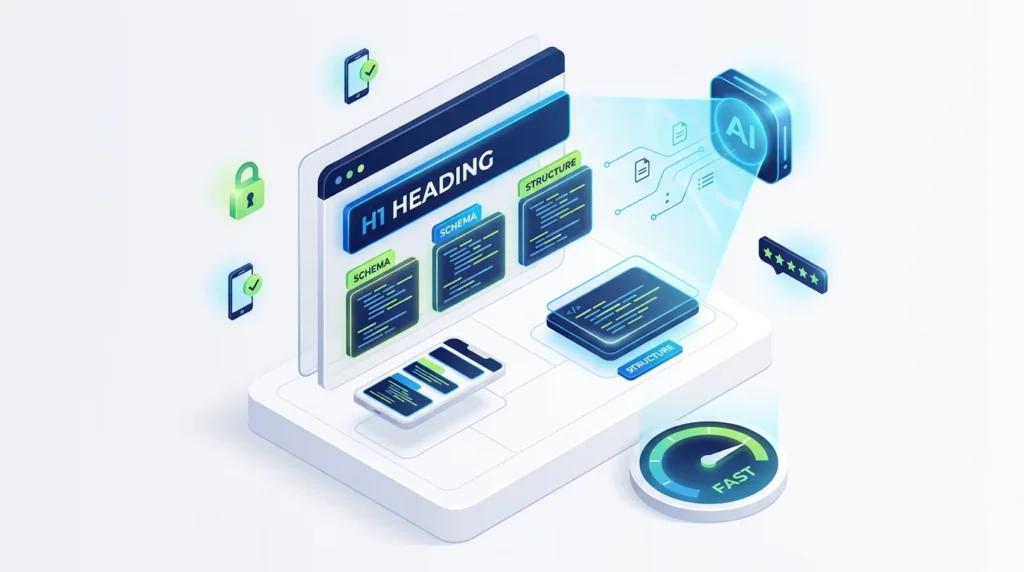
You don’t need to understand code to follow this section. You just need to hand it to whoever manages your site.
Site structure. AI reads a page the way a distracted person does — it scans headings. Your H1, H2, and H3 tags should tell a clear story on their own. Navigation should be simple. Each page should have one main topic, not six.
Page speed. Slow sites lose. If your site takes more than 3 seconds to load on mobile, that’s hurting you with real visitors and with AI crawlers. Dental clinics, roofing companies, gyms, electricians — any business running a site that hasn’t been touched in a few years is likely sitting on a speed problem. Check your site page speed.
Schema markup. For local businesses, the basics are: your business type (MedicalClinic, AutoRepair, LegalService, Restaurant, BeautySalon for spas, RealEstateAgent, Electrician, etc.), your name, address, and phone number, your hours, your services, and any reviews you’ve collected. Without this, you’re harder for AI to categorize correctly.
Mobile usability. More than 60% of local searches happen on phones. If your site is hard to use on a phone screen, you’re losing people before they read a word — and AI systems notice this too.
HTTPS. If your site still runs on HTTP, that’s a trust problem. Fix it before anything else.
Content changes that actually get you mentioned by AI
Most local businesses have the technical stuff close enough. The content is where they fall apart.
Write like you’re answering a specific question, not describing your company. “Our experienced team provides comprehensive plumbing services” tells an AI nothing useful. “We fix burst pipes, install water heaters, and handle drain blockages — usually same-day for emergency calls in [city]” is something an AI can actually quote when someone asks what plumber to call.
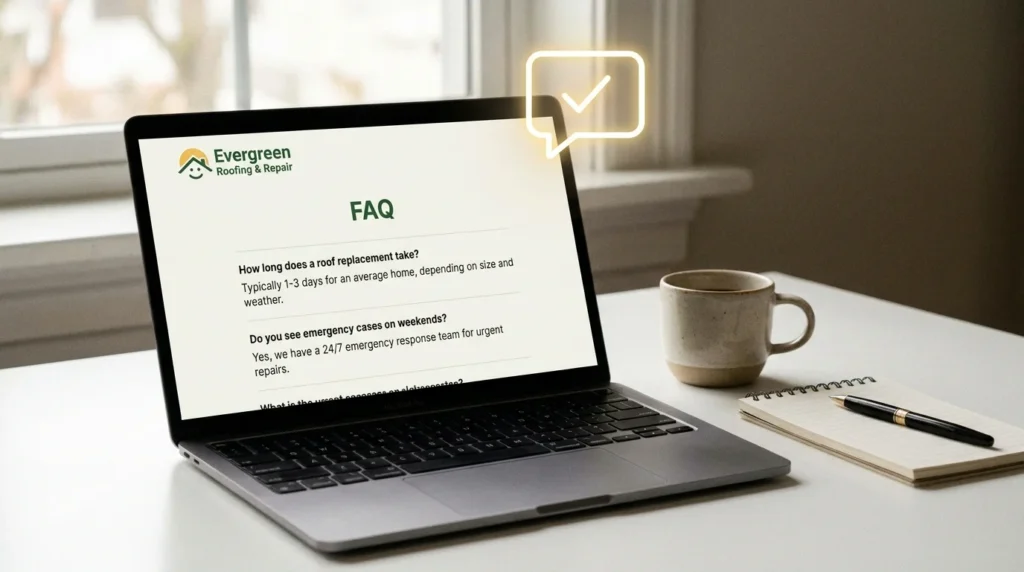
Add FAQ sections to your main service pages. This is probably the single most useful content change most local businesses can make. Real questions your customers ask, answered directly. Not marketing language — actual information.
For a roofing company: “How long does a roof replacement take?” For a vet clinic: “Do you see emergency cases on weekends?” For a restaurant: “Do you take reservations for large groups?” For an HVAC company: “What size unit do I need for a 2,000 sq ft home?” For a med spa: “Is laser hair removal safe for darker skin tones?” For a real estate agent: “Do you charge a buyer’s agent fee?” For an electrician: “How much does it cost to rewire a house?”
FAQ sections work because they’re already in the format AI uses to respond. The match is obvious.
Write in plain language. The closer your site reads to how a knowledgeable person talks, the better AI handles it. Drop the corporate copy. Write the way you’d explain something to a customer who just walked through the door.
Get specific about location. “Serving the greater metropolitan area” is not useful to an AI. “Located in Midtown Atlanta, serving Buckhead, Decatur, and East Atlanta” is. Name your neighborhoods. Name nearby landmarks if they’re relevant. AI uses location specificity to figure out who to recommend for local queries.
Write content that answers what your customers are actually searching. A medical clinic should explain what happens at a first visit. A general contractor should walk through how permits work. A chiropractor should explain what to expect after a first adjustment. A law firm should explain what the first consultation covers. A med spa should explain the difference between its treatment options. A real estate agent should explain what the buying process looks like step by step. An electrician should explain what’s included in a service call. This is the kind of content AI pulls from when someone asks an honest question.
How to check whether AI can currently see you

Before paying anyone to fix anything, run these checks yourself.
Open ChatGPT and ask: “What are the best [your service] providers in [your city]?” Try a few different ways of phrasing it. See if your name comes up. Note whose names do.
Do the same thing with a Google search. Look at the AI Overview at the top of the results page. Who gets cited? What information does the AI use?
Go to Google’s Rich Results Test and paste your website URL. It’ll show you what schema markup your site currently has — and flag anything broken.
Go to PageSpeed Insights and run your homepage. If you’re below 50 on mobile, that’s a real problem.
Then read your own homepage out loud and ask yourself: if an AI’s only job was to answer “what does this business do and who is it for,” could it answer that question from your homepage alone? If the answer is no or maybe, that’s your starting point.
Where to go from here
A lot of local business sites were built to look good in 2015 or 2018. They do. They just aren’t built for how people find businesses now.
The businesses showing up in AI answers aren’t necessarily the biggest or the most established. They’re the ones with clear pages, honest information, proper schema, and content that answers real questions. That’s fixable for almost any local business — dental clinic, plumber, spa, med spa, general contractor, real estate agent, law firm, landscaping company, restaurant, chiropractor, medical clinic, auto repair shop, gym, vet clinic, electrician, roofer, or HVAC company.
If you want to know where your site stands right now, we offer a free AI-readiness audit. We check your technical setup, your content structure, and your current visibility in ChatGPT and Google’s AI Overviews, then give you a plain-language breakdown of what to fix and in what order.